One-step purchase
Overview
When performing an one-time one-step purchase, you can use one of the following options to transfer payment details:
- Transfer of complete payment details This is a basic option in which you collect all payment details from the customer, and then submit the data inside a payment request.
- Transfer of payment details identifier To enable this option, you need to perform an initial COF payment. Once you do this, the payment platform creates a payment instrument record and returns a callback with the ID of the record in the
account_idorcard_idparameter. You need to specify this ID each time you submit to the payment platform a request for payment using stored credentials, see Saving payment data - Transfer of payment token To enable this option, you need to perform an initial payment. Once you do this, the payment platform creates a payment token and returns a callback with the token in the
tokenparameter. You need to specify this ID each time you submit to the payment platform a request for payment using stored credentials. For more information about using tokens, see Tokens.
Workflow
When ordinary processing a one-step purchase by using Gate, the merchant web service is required to do the following:
- Send the one-step purchase request with payment details to one of the relevant endpoints in the following group:
/v2/payment/{payment method}/sale[/specifying payment details]. - If necessary, complete the additional procedures:
- 3‑D Secure 1 authentication. This authentication is intended to provide security to online payments by payment cards. For more information on the authentication workflow, as well as request and callback formats, see Customer authentication by using the 3‑D Secure 1.
- Customer authentication on merchant's request. This authentication is intended to make purchases with payment cards more secure. For more information on the authentication workflow, as well as request and callback formats, see Authentication on merchant's request.
- Additional payment information submission. This procedure is intended for cases in which the initial request did not contain the information needed by one of the payment process stakeholders (including authenticating customers). For more information on this procedure, see Submission of additional payment information.
- Receive a callback with the payment result from the payment platform.
- If needed, after completing a one-time one-step purchase you can return your customers their money, if the payment method supports refunds. For more information on this procedure, see Purchase refund.
The following diagram provides the detailed picture of an ordinary one-step purchase processing procedure without additional requests.
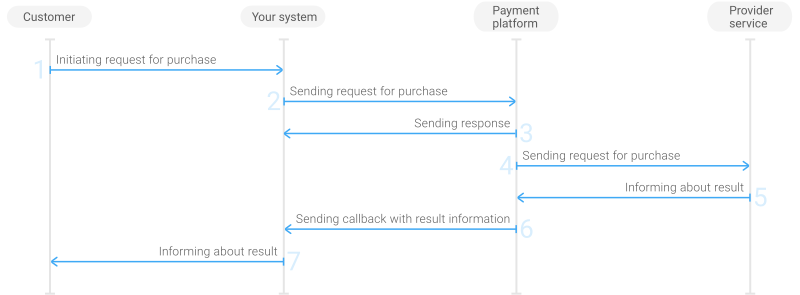
- The customer initiates a one-step purchase in your system.
- Your system sends the one-step purchase request to the payment platform.
- The payment platform sends you a response in which it acknowledges your request and provides the request validation result.
- The payment platform sends the one-step purchase request to the provider service.
- The provider service informs the payment platform about the purchase result.
- The payment platform sends the callback with the payment result to your system.
- Your system sends the payment result to the customer.
The sections that follow discuss in more details the request format and the required parameters and the information about the format of callbacks with payment results. For the general information on how to use the API, see Integration procedure.
Request structure
The request structure described in this section is applicable to one-step purchases with payment cards. Listed below are the requirements to payment request structure:
- The request is sent by using POST (HTTP) method to one of the following endpoints:
- /v2/payment/card/sale—when the request contains the complete card details
- /v2/payment/card/sale/saved—when the request contains the identifier instead of card details
- /v2/payment/card/sale/token—when the request contains the card token instead of the card details
- The following objects and parameters must be specified in the request:
- Object general—general request identification information:
- project_id—project ID you obtained from maxaa
- payment_id—payment ID unique within the project
- signature—signature created after you specify all the required parameters. For more information about signature generation, see Signature generation and verification
- Object customer—customer information:
- ip_address—IP address
- id—the ID of the customer within the merchant project
- Object payment—payment information:
- amount—payment amount in minor units
- currency—payment currency in the ISO-4217 alpha-3 format
- Object general—general request identification information:
- The request should contain the following customer payment card information:
- when specifying complete card details—the following information is required in the card object:
- pan—card number
- year—year of expiration date
- month—month of expiration date
- card_holder—cardholder's first and last name (as indicated on the card)
- cvv—card verification code (CVV), as indicated on the card
The cvv parameter is not required and not passed in payment requests for cards with no CVV. For more information whether the cvv parameter is optional, contact your key account manager.
- when indicating the identifier—the following information is required: the identifier which is associated with the card details in the payment platform in the saved_account_id parameter and the card verification code in the cvv parameter provided the card has a verification code (CVV).
The cvv parameter is not required and not passed in payment requests for cards with no CVV. For more information whether the cvv parameter is optional, refer to your key account manager.
- when indicating the token—the following information is required: token in the token parameter and the card verification code in the cvv parameter—provided the cvv parameter is supported for the card.
The cvv parameter is not required and not passed in payment requests for cards with no CVV. For more information whether the cvv parameter is optional, refer to your key account manager.
- when specifying complete card details—the following information is required in the card object:
- The request must contain the return_url object with the addresses for redirecting the customer to your system:
- success—the URL for redirecting the customer after the payment is completed;
- decline—the URL for redirecting the customer after the payment is declined.
- return—the URL to redirect the customer to when they prematurely terminate the payment. This URL is also used if the success and decline parameters are not specified in the request.
- Depending on specific regional requirements and requirements of providers and payment systems, you may be required to add the following additional user information:
- first_name—first name
- last_name—last name
- middle_name—middle name (or patronymic)
- day_of_birth—birth date
- phone—phone number
- email—email address
- zip—post code of residence location
- address—address (street, house number)
- city—city of residence (town, village, etc.)
- district—district of residence
- state—region of residence (state, county, canton, etc.)
- avs_post_code—post code registered with issuer as customer's actual post code
- avs_street_address—street and house number registered with issuer as customer's actual address
If some parameters are missing from your request, the payment platform may require you to submit additional payment information. For more information about submitting additional payment information, see Submission of additional payment information. For details what parameters are required in your case, refer to your account manager at maxaa.
- If required, you can also add any other additional parameters Gate supports.
Here is an example of a payment request:
{
  "general": {
      "project_id": 42,
      "payment_id": "456789",
      "signature": "v7KNMpfogAxwRIL9tVftZ1ZZ5D/aZAeb0VMdeR+CqGrNxYyilUwSm...=="
  },
  "customer": {
      "ip_address": "248.121.176.220",
      "id": "customer_12"
  },
  "payment": {
      "amount": 400000,
      "currency": "USD"
  },
  "return_url": {
        "success": "http://example.com/return",
        "decline": "http://example.com/decline"
  },
//when indicating complete card details:
  "card": {
      "pan": "4242424242424243",
      "year": 2025,
      "month": 8,
      "card_holder": "JOHN SMITH",
      "cvv": "123"
  }

//when indicating the identifier of a stored payment card:
    "saved_account_id": 2345678,
    "cvv": "123"

//when indicating the token of a stored payment card:
    "token": "f365bb1729f9b72fd9c09703a751c979f3becc679f29c3e35c91d18070d15654",
    "cvv": "123"
}
Customer redirection data format
- url—URL to redirect the customer
- body—additional data required in the request to payment system (may be empty)
- method—method to use to submit the request
The payment platform sends callbacks with redirection data to the URL specified in your project settings. The payment remains in the awaiting redirect result status until the customer completes the payment.
If the body parameter contains no data, it is added to the callback as an empty array, otherwise it is added to the callback as a JSON object. Shown below are examples of using the body parameter in the callbacks with redirection data.
"redirect_data": {
              "body": [],
              "method": "POST",
              "url": "https://example.com/redirect/absd1234"
}
"redirect_data": {
            "body": {
                 "Reference": "2000016"
              },
              "method": "POST",
              "url": "https://example.com/redirect/absd1234"
}
Callback structure
A one-step purchase uses the standard format for callbacks to submit purchase results. For more information, see Callbacks in Gate.
The following is the example of a callback with an information about successful 4,000.00 USD purchase the customer_12 made by using the payment card № 424242******4243 in the 42 project.
{
    "account": {
        "number": "424242******4243",
        "token": "f365bb1729f9b72fd9c09703a751c979f3becc679f29c3e35c91d18070d15654",
        "type": "visa",
        "card_holder": "JOHN SMITH",
        "id": 45678,
        "expiry_month": "08",
        "expiry_year": "2025"
    },
    "customer": {
        "id": "customer_12",
        "phone": "44991234567"
    },
    "payment": {
        "date": "2019-01-11T13:02:42+0000",
        "id": "456789",
        "method": "card",
        "status": "success",
        "sum": {
            "amount": 400000,
            "currency": "USD"
        },
        "type": "purchase",
        "description": ""
    },
    "project_id": 42,
    "operation": {
        "id": 969000002636,
        "type": "sale",
        "status": "success",
        "date": "2019-01-11T13:02:42+0000",
        "created_date": "2019-01-11T13:01:45+0000",
        "request_id": "c6eed1eb14c629b4ef20b3b8086d...d04132c34b0088cbc0be4667c",
        "sum_initial": {
            "amount": 400000,
            "currency": "USD"
        },
        "sum_converted": {
            "amount": 400000,
            "currency": "USD"
        },
        "provider": {
            "id": 408,
            "payment_id": "330157196",
            "date": "2019-01-11T13:02:32+0000",
            "auth_code": "",
            "endpoint_id": "612266625"
        },
        "code": "0",
        "message": "Success",
        "eci": "07"
    },
    "signature": "v7KNMpfogAxwRIL9tVftZ1ZZ5D/aZAeb0VMdeR+CqGrNxYyilUwSm...=="
}
The following is the example of a callback for a one-step purchase declined due to incorrect card data entered.
{
    "project_id": 42,
    "payment": {
        "id": "456789",
        "type": "purchase",
        "status": "decline",
        "date": "2019-01-11T14:11:33+0000",
        "method": "card",
        "sum": {
            "amount": 400000,
            "currency": "USD"
        },
        "description": ""
    },
    "account": {
        "number": "424242******4243",
        "type": "visa",
        "card_holder": "JOHN SMITH",
        "expiry_month": "08",
        "expiry_year": "2025"
    },
    "customer": {
        "id": "customer_12",
        "phone": "44991234567"
    },
    "operation": {
        "id": 13300000004505,
        "type": "sale",
        "status": "decline",
        "date": "2019-01-11T14:11:33+0000",
        "created_date": "2019-01-11T14:11:00+0000",
        "request_id": "c6eed1eb14c629b4ef20b3b8086d...d04132c34b0088cbc0be4667c",
        "sum_initial": {
            "amount": 400000,
            "currency": "USD"
        },
        "sum_converted": {
            "amount": 400000,
            "currency": "USD"
        },
        "provider": {
            "id": 12,
            "payment_id": "48219213050",
            "auth_code": "",
            "endpoint_id": 12
        },
        "code": "10102",
        "message": "Incorrect data entered",
        "eci": "05"
    },
    "signature": "v7KNMpfogAxwRIL9tVftZ1ZZ5D/aZAeb0VMdeR+CqGrNxYyilUwSm...=="
}